Dr. Doug Cardell: Why Socialism Struggles — And Why It's Popular Now
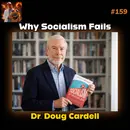


Socialism is having a moment in America after the midterms. Economist Dr. Doug Cardell, author of Why Socialism Struggles, sits down with me to explain why central planning keeps failing — and why the cost of living is making the sales pitch land.
Doug is a former congressional aide who taught mathematics and earned his PhD in public policy at Liberty University. His dissertation asked whether a centrally planned economy can outperform free markets. He walked through 30 years of Federal Reserve forecasts of real personal consumption expenditures: they were right 46% of the time, worse than flipping a coin, and sometimes wrong even on the direction.
We get clear about terms people throw around and rarely define — socialism, communism, fascism, democratic socialism — and why he says real progress took off with value creation, not with taking from somebody else. We talk about why socialism is popular right now, the DSA’s agenda, how government policy helped break health care and college costs, and what a New York rent freeze actually does to housing. Doug’s line is that government should set guardrails and stop abuses, not tinker with a complex system and hope for the best.
He also lays out reforms from his time as a House aide: every bill gets an expiration date, every bill is a single issue, and lobbying has to be curtailed, because a committee of 435 people defaults to letting lobbyists run the game.
If you want more from Doug, he told us to go to DougCardell.com and pick up Why Socialism Struggles. He’s working on a follow-up book, and we left the door open for another conversation.
Follow Dr. Doug Cardell on Facebook: https://www.facebook.com/profile.php?id=61576715924348
Watch and subscribe at worldablazepodcast.com.
Timestamps: 00:00 Introduction: Dr. Doug Cardell and Why Socialism Struggles 03:15 Why socialism and central planning fail 08:10 Capitalism as the engine of progress 15:05 Socialism, communism, and fascism — defined 24:20 Value creation, cost of living, and the DSA 45:15 Government failure in healthcare and education 51:50 Guardrails vs. intervention: rent control 1:05:10 Political reforms and lobbying 1:25:35 Closing thoughts and where to find Doug
Web: https://www.worldablazepodcast.com/
YouTube: https://www.youtube.com/@fontesablaze/featured
Instagram: https://www.instagram.com/fontesablaze/
TikTok: https://www.tiktok.com/@fontesablaze
Substack: https://substack.com/@fontesablaze
If you like the show, please leave a rating and review on Apple Podcasts.
00:00 - Introduction to socialism and economics
03:15 - Critique of socialism and central planning
08:10 - Capitalism as the engine of progress
15:05 - Defining socialism, communism, and fascism
24:20 - The importance of value creation
45:15 - Government failure in healthcare and education
51:50 - Guardrails, rent control, and intervention
01:05:10 - Political reforms and lobbying
01:25:35 - Closing thoughts and future projects
0:00 Welcome to another World Ablaze. Today, my special guest is someone who has been going back and forth with me for a while trying to line our schedules up, and I'm so glad we finally made this happen. My guest today is Dr. Doug Cardell, economist and author of Why Socialism Struggles, Exposing the Economic Errors that Undermine Utopian Ideals. He's taught mathematics, worked as a congressional aide, and has obtained his PhD in public policy at Liberty University with a dissertation on whether a centrally planned economy can outperform free markets.
1:02 And this is a timely, timely interview with Doug, given the situation in America, the sentiment towards socialism and seeing representatives who lean towards socialism be elected to represent the people of America right now. And so with that, let's welcome Doug Cardell, sorry, Dr. Doug Cardell into the fold here on screen. There he is. How are you, sir? I'm great. Happy to be here, George. Yeah, I'm glad you're here too. It took a little bit. And then I apologize for that. My schedule has been all over the place. And so I think this is perfect though, especially after what we saw after the midterms. And at some point, we're going to go back to Mom Donnie, because I know that you were critical of him as being an experiment of socialism and practice in America and seeing how that went. So we're going to go a few different directions here.
1:55 But first, I got a few questions to ask that will be basically... I derive these from your past interviews as well as things that were in your book. So this whole conversation, I believe for everybody is going to be educational. And I'm here to learn from you. And I'm here to get your take on things in the situation that America is seeing right now, especially when it comes to the economy, because that was the huge talking point, the huge narrative that was driven as to why the midterms turned out how they did, because apparently Republicans weren't addressing the economy. So with that, I got the first question here that I wanted to ask you, okay?
2:35 And that was about your book. And I'm going to look over a little bit because I want to make sure I wrote some of these down just so I don't sound like I'm unprepared. So, Doug, so the book, basically you came through writing this book through a mix of what you went through as working as a congressional aide, teaching mathematics, etc. And so what I wanted to know is what did you see behind the scenes or in those rooms that made you want to write Why Socialism struggles well but i guess my first recollection about socialism was when i was about 12 um i remember a woman i honestly don't remember who it was now it could have been a teacher i i don't know um was explaining to me how wonderful communism was and she talked for about 20 minutes and I listened and she said, isn't that great?
3:34 And I said, well, that won't work. She said, what do you mean that won't work? I said, well, it'll only work if people are saints. You're expecting people to constantly spend their time working against their own self-interest and they won't do that. You can try it, but it's not gonna work. And she was just stunned. And so I guess from that time on, And I was suspicious of socialism, communism. We can talk about them as being the same thing. There's no fundamental difference. And so then that colored a lot of things that I did throughout my life, of course.
4:17 As I got better at math and economics and so on, I wanted to actually study it in greater detail. and my dissertation was looked at a 30-year history of the Federal Reserve trying to predict the real personal consumption expenditures. That's a measure of what people are going to buy in the next year, basically. And it's something that would be critically important if you were trying to plan an economy. Let's sort of picture that in our minds. If you and I and our listeners were put in charge of earning the economy, we would have to make decisions about what we would buy next year, what would be made next year, what people wanted next year. And right now, there's 9 billion people on the planet, and that means we would have to basically read their minds.
5:15 and the reality is i don't know what my wife is going to buy next week how could i possibly figure out what is going to do a year from now it's and as it turned out the fed i looked at what they predicted looked a year later to see what would happen and they were right 46 of the time well you could literally do better flipping a coin and many of the times they were not off by the amount, but also by even the direction. They thought spending was going to go up and it actually went down and so on. And so whether your concerns with socialism are about the morality of it, the idea that I talked about when I was 12, the idea that you're asking people to be inhuman, you're asking them to behave as saints, or because of the fact that it just won't work, it's hard to find any justification for advocating socialism.
6:23 I think one of the major things that you pointed to that's important is what I found in socialism, which always leads to communism for whatever reason, is that they do remove the human element or the human propensity to look out for themselves and control their environment. They're going to want to elevate themselves. And by doing that, they're going to have to control those below them to basically kick up to them so they can continue to live the lifestyle or have the power they have. And so you're always removing the middle class. It becomes more like the lower class and the ruling elites. There's really no more middle class when you get into those systems. And again, as you said, you're really relying on people being complete humanitarians, selfless individuals, which is just not the case and never will be in human history.
7:12 I've never seen it. So that's a very important point there. And go ahead. I would go even further and say that it's not a measure of humanity. It's a measure of life. any organism that does not pursue its own self-interest will die yeah it's just it's it's in nature it's in nature yeah uh and so you don't see in anywhere in nature uh bacteria giving up their self-interest they they do what they do and and so socialism, I would say, is anti-life.
7:59 You're saying we're going to do something that no being that ever existed would actually do. Would you say socialism could be literally a regression of progress? Oh, for sure. And essentially, Marx planned it that way. Marx claimed to like the progress that capitalism made but he didn't like the way it was done but everything he actually suggested as alternatives betray an unconscious maybe or not stated fear of progress he put in place a system that guarantees you cannot progress uh and i guess to to sort of put that in perspective i think we have to take a brief walk through history and look at how things actually change because 500 years ago the socialists had a point there weren't actually socialists back then but but the world was a different place in fact if you look at the world from year one to 1500 what happened nothing if you look at per capita gdp
9:29 that is a measure of how much each individual was producing it didn't change for 1500 years now imagine that 1500 years with no progress and so back then if you wanted more you had to take it from somebody else it's the way the world was there was only a fixed amount of stuff and because of that if you wanted more you had to get take it from somebody else so Robin Hood was right. It made sense then to steal from the rich to give to the poor. But in 1500, things started to change.
10:12 Between 1500 and 1800, we saw the beginnings of capitalism. And during that 300 years, per capita GDP went up 40%. So 1500 years of no progress, 300 years, and it's 40% better. That's big. That's really, really big. So if you can, I love the explanation, but can you define what that tipping point was from a society that resembled socialism to one that had to move into capitalism? Because was it due to it just being a more smaller, disconnected world to then becoming a more intertwined world with global markets and whatnot as it started to progress and societies became bigger and more complex?
10:57 It was more a matter of the invention of capitalism. A good example would be, it's a little later, but a good example would be James Watt and the steam engine. He, up until around 1500, the ideas that people wanted to put in place were put in place by government. Individuals didn't do stuff. but james watson i've got this cool idea for how to make a better steam engine capitalists venture capitalists that's what capitalism is for those who don't know it's you're you're looking someone has an idea that they're an entrepreneur and they're looking for a way to implement it. And what they need to do that is a venture capitalist. And so James Y was an example of one of the early capitalists that had to go fight, had a big idea that he couldn't do by himself, and he couldn't convince government to do it for him. Before that, like think about Columbus. Columbus didn't go get investors. He got the Queen of Spain to back him. That's the way it was done back then if you if the only way you could do it was with government help right ruling class yeah yeah but james watt was one of the one of the early adopters of capitalism and and that triggered a huge boom the industrial revolution basically was based on it exactly
12:34 And but. In 1800, things got even better between 1500 to 1800. We got things 40 percent better. From 1800 on, huge changes started happening. And it was almost all due to the United States. The first country in human history based on capitalism the first country in human history to have patents enshrined in the Constitution Without patents you can have capitalism Without patents, you can't have dynamic economic growth because who's going to go out and spend money and time and effort to build something that somebody else can take away from?
13:16 Right. And so from 1800 to today, the world is 18 times better off than it was in 1800. We're not talking just 40% now, 18 times better off. And in the developed world, the US, Europe, Japan, it's more like 40 times better off. That is per capita GDP is 40 times higher than it was in 1800. were producing like crazy and taking the benefits of that. And so basically that early 1500 years, and of course the time before that, we just don't have records before that, so I can't prove it.
14:04 But basically throughout human history, things were stuck. And it took the invention of capitalism to unstick things. And the difference has been huge. Capitalism has lifted more people out of poverty than anything you ever imagined. In 1950, 37% of the world lived in extreme poverty. Now it's 9%. And we're getting very close to eliminating extreme poverty. So we're looking at huge changes all caused by a simple change in the economic system. So could we argue then that capitalism was going to be the inevitable result of the need for human progress and invention?
14:50 Yeah, I don't see that there's an option. With innovation, you're going to need capitalism, right? So that innovation could progress, right? Let me ask you this, Doug, because these terms keep getting thrown around and one leads to another. We kind of brought it up earlier, but it's like politicians, various people are throwing around like socialism, capitalism, fascism, Marxism. And then there's democratic socialism, which is kind of like, I don't see how that works. So everyone shares these definitions, but nobody's really defining it. It's like they're just kind of meshing and covering each other up and not really.
15:33 I think people are conflating the meanings of each and where each one leads. Can you kind of define that for us? And I'll also explain how it is that socialism actually leads to communism and how that can lean toward authoritarianism or a dictatorship in terms of a government. Sure, sure. Well, socialism is an economy where the government owns all property and the means of production. now like most economic systems it's actually fairly rare but today you could probably say north korea is clearly socialist cuba is probably socialist that's about it uh communism is imaginary okay most people don't in marx's view communism is what would happen when socialism got so successful.
16:33 The government owns the means of production, it owns the property, and it's running things so well that the government would fade away. And then we have communism. A socialist state with no government. If you believe that, I've got a bridge I'll sell you. And that's never happened. There's never been a state with no government. Yeah, try and imagine that. I mean, it's another one of those things is completely against human nature. You give people power and they're going to fight to keep it. They're not going to go. Oh, absolutely. Yeah. And so, yeah, the government is not going to wither away. So the other thing people talk about a lot is fascism.
17:14 Now, right now, for example, China is closer to fascism than it is to communism. They call themselves communists, but they do not own the means of production. They do not own all property, but they control all of it. And that's what fascism is. Fascism is when the government owns, does not own the means of production, but controls it directly. And they don't all own all property, but they control it directly. A good example would be Hitler's Germany. That was, we all know, is a fascist country. And an example of how Hitler controlled the economy is the Volkswagen. He had an idea for what he called the people's car. He went to Porsche and said, we want you to stop making everything you're making now, make this car. And Porsche said, okay, fine. And they did. And that became the car you could buy in Germany.
18:09 And so I'm not saying there's anything wrong with Volkswagen because I had one in college and it was fun. But the point is, is that Hitler was running the economy and it eliminated people's choice. They couldn't buy a Porsche 911 anymore. They had to buy a Volkswagen. And if that's the world you want to live in, well, maybe fascism or socialism is something you'd be happy with. But that's not the world that most people envision when they talk about socialism. And you mentioned democratic socialism. That's an oxymoron. Yes, it is. Democracy and socialism are completely incompatible. And it's easy to see why. If you don't have economic freedom, by what measure do you have freedom? In other words, if I can't buy what I'd like, if I can't make what I'd like, if I can't manufacture and sell what I'd like, I clearly don't have freedom. And the things that they want to do on my website, I'm just finishing up my last series of articles on the Democratic Socialists of America.
19:20 I've taken their entire platform and described what it actually means and why it can't work. But what they're advocating for is a state where everyone is equal. That's part of a big part of their dream. And it's a stupid dream. We aren't equal. anybody who thinks we are is hallucinating now should we be equal in the eyes of the law absolutely should we treat everyone equally absolutely but we're not equal and we shouldn't be that's the part that they don't get being equal would be a disaster one of the things i do in my book is i take i think a dozen or so famous people and interchange their roles and i say how would you like it if Julia Roberts was running D-Day?
20:18 Would you want Paul McCartney to be running nuclear physics? Yeah. These are all great people, but they're not equal. They have different talents, different abilities, and different educations. And it's that kind of diversity that we want. they keep saying they want diversity but they don't want diversity they want things to be homogeneous they want everything to be everybody to be the same they want drones and and the people don't want that but they don't understand that that's what's really being advocated they don't see that that's what's what's in store if they get what they want and so yeah as an example what one of the things they want is for everybody to make the same amount of money.
21:11 They don't see that there's choices involved there. I'm also a musician. I've got a lot of friends who are musicians. I've got some friends that that's their gig. That's all they do. They don't have a second job. They typically don't do very well financially. But they're happy about that. now why would the democratic socialists want to take that away and say no you can't do that because we want you to do something that will make you the same amount of money as everybody else and we all make choices every day that affect how much money we make and most of the people I know are happy with their life.
21:59 They have careers that please them, but all of those careers don't make the same amount of money and there's a reason for that. It's because every input doesn't have the same value. That's another part that the socialists get horribly wrong is they think that they can assign value. they can say, this should be worth this much. They particularly do it with labor. They say, an hour's labor is worth $25. Well, that's just stupid. I can go out in my yard right now and start digging holes and filling them up again, and I've done a huge amount of labor, but nobody's going to pay me for it because I created no value.
22:46 I didn't do anything that was any good for the world. It was labor without purpose. Yeah. Yeah. And a lot of the things that people choose to do don't have as much value as what other people go going back to music. Why are the Beatles more richer than the Grateful Dead? Well, they created more value for people in the people's eyes than the Grateful Dead did. Now, I don't think the Grateful Dead are whining about that. They got to do what they wanted to do and made a good living doing it. but they didn't create as much value for the people as the Beatles did. And that's the bottom line is that the people are the only judge of value.
23:31 There is no other judge. And so if somebody comes to me and says, I want to, you know, rake leaves in your yard, but you have to pay me $25 an hour. I'm going to say, you know what? It's not worth $25 an hour. I can do it myself. And I'm happy to. and that's that's why we saw that's why there's all those self-checkout lines that's why grocery stores went that way is that they realized really quickly that the people would rather check their own groceries than to pay somebody 25 an hour to do it for them it wasn't the stores that did it it was the people that did it the people said hey you put into self-checkout and I'm there because it's not worth it to me to pay the difference.
24:19 Yeah. Well, so there's a lot to unpack in everything you said. Yes. So let me address some of that because I agree with you and there's some things I want to get some clarification on. We can't deny that socialism is popular right now and it's because of the cost of living really. And then when you're talking about the DSA and their agenda, absolutely their agenda to me is really to topple the usa as we see it okay socialism in and of itself and you are more studied than i am in this so if i get this wrong get it wrong you can correct me but they want everything to be equal and they're going to define what things are worth and it's like when you're taking away the freedoms and you're taking away the choice then that that's ultimately what they're doing is they're telling you that you're going to live by their laws and do it how they want.
25:13 And again, they're just taking away the middle class. So your example of the musician, I get it. Like that person can make less but be happy. But at the same time, the value they put on things doesn't make sense for, let's say, a doctor who's used to making $300,000 or $400,000 a year. And these elitists, we can call them elitists. I don't mean they're elitists in terms of people looking down on others, but just in their income level, right? And a lot of people would refer to them as elitists because of that. But just using this for example's sake. So that doctor who's used to that, who thinks that under, for example, if they support the socialist agenda, think that they're going to be saved because they are an elite or a person above others that are valued more. But once those socialists gain power, there's always going to be a group at the top that's going to control the others.
25:56 Someone has to make a decision. Like I said you never going to see an example where there isn a government involved There always going to be a governing body So once those people are involved they can look down on these doctors and say hey thanks for the support But now we think you worth about a year And so is the cab driver. And so is the guy making the burgers and everything else. So when you do that, there's no longer an incentive for anybody to be going back to what you said about being innovative or wanting to increase their skill level or gain new skills. Because then at that point, what is the point, right? So socialism actually oppresses people through that type of system inherently. But with all that, you know this. I know this.
26:36 Many other people understand this. So what is the appeal right now? What is the appeal? I mean, yes, cost of living is high, but it's not at the point where they need to turn to a system such as socialism. So where's that disconnect, you think, in terms of people understanding the dangers of turning to a socialist system? Oh, I think there's more than one thing at play. I think the first thing is people don't understand capitalism. They don't understand the generation of wealth. So let's take a look at a few examples. Right now, I'm on a PC.
27:16 I don't know what you're on, but I couldn't be talking to you right now if it weren't for Bill Gates. just that simple and i'm i live out here in the middle of nowhere and so i'm on starlink satellite i couldn't talk to you if it weren't for elon musk and what people don't get is these people are rich yes but they got rich by creating value for us. My life is better thanks to Bill Gates and Elon Musk. That's not deniable. Everyone's life is better thanks to Bill Gates and Elon Musk. And if you want to put numbers on it, let's look at Jeff Bezos. Amazon, I've run the numbers, Amazon makes every American's income $2,500 to $3,000 a year more by the money they save them.
28:14 Amazon saves the average American $2,500 to $3,000 a year. So why do I care if he's a billionaire if he's making me $3,000 a year richer? It's just stupid thinking. But it's because people don't understand. They don't know, they don't see what's really going on. And going back to our earlier example, the reason why things changed in 1800 is that now Robin Hood is dead. That idea doesn't make sense because now the rich don't get rich by taking from other people.
28:56 They get rich by creating value for other people that they profit from. And that's a good thing, not a bad thing. I would challenge our listeners right now, take a glance around your house. What have you got there that government gave you and what have you got there that capitalism gave you? And I know what the answer is. And it happens quickly. I think another part of the problem is that youth today feel somewhat disaffected. And I can understand that. But it's also because they don't look at the actual math.
29:36 Can you define how they feel disaffected? Yeah. They see people like me. I'm an antique. I'm 78. And they see people my age, boomers, as having this good life that we were magically brought into. And that they aren't getting that good life. and so they they say well you got this this house and this blah blah blah and i don't get that why don't i get that too well they're first of all not looking at the fact that that people my age spent 50 years working to create to build that life working and honing your skills and yeah I didn't have all that when I was their age either.
30:26 And in fact, when I was their age, and I know they hate these boomer stories about I had to walk up till three miles to school and all that nonsense. But here's some actual facts. My family was middle class. And my dad was working the whole time. We had a family of six. The house we lived in was 961 square feet. now by today's standards that would be like two tiny houses yeah okay the average house today is 2,500 square feet yeah that's huge i mean even yeah yeah and so they're complaining that the house costs more well of course the house costs more three times bigger and more than that in that 961 square feet i had a family of six today the average house has a family of three so that the average house per person is six times bigger than it was when i was a kid but it doesn't cost six times more it costs more agreed but not six times more in an inflation adjusted dollars of course and so and also when i was a kid we didn't have cell phones are you kidding me we had what was called a party line and kids today don't even know what that is. It would mean that if I wanted to make a phone call, I had to go to my phone, which there was one in the house attached to the wall. And I had to pick up the receiver, listen, and see if
32:01 anybody was already talking. And if they were, I would say, excuse me, I need to make a call. Could you ring back when you're done? And then I would hang up. And sometime later, the phone would ring and then I could pick it up and get a dial tone. Hey, there were no microwaves. The washing machine was a big tub that would sort of spin around and you would take the clothes out of it and put it through a thing called a ringer. It was two cylinders that you turned to crank and the clothes would go through it and get wrung out. And then you would take them and put them on the dryer, which was a string of wire outside the house called a clothesline. We had no microwaves, none of that stuff. So when people complain about how good the boomers have got it now, We've got it good now because we built from that to what we have now.
32:54 We created our lives that way, and they need to do the same. And I'm not saying that they're whiners or anything like that. I understand that in their minds, they're suffering. I can see that. and and i don't begrudge them that but it's because they don't see the big picture the way it really should be and i think a lot of that too is going back to what we talked about with value um we don't teach people really well about value i think it's in my dream world one of the first things we would do in education is help people find out what their talents are. We don't do that.
33:50 We give the same education to everybody. And too often we pass people along in things that they shouldn't be passed along in. It's because people think of failure as being a bad thing. I've failed a lot in my life. That's a good thing. Yeah, well, it's how you learn. That's exactly. It's the only way to learn. And if you never fail, you never improve. And so if you want to improve, you have to fail. It means you have to try things that you don't know what the outcome will be. And when you make an experiment and it doesn't go the way you envision, that's not failure. That's a learning experience.
34:31 and if I'm in school and I am making A's in art and F's in math that's sending me an important message that maybe a career in nuclear physics is not for me and I need that message but then there's another part to that that we don't do in education that we should and that is help people find their bliss we should be helping people find what they love to do And then if I could tell young people anything I could, I would say this. Find your talent. Spend a year or two finding out what you're really good at.
35:14 Find your bliss. Find out what you really love doing. Then find a way to put those two things together and create value for other people. When you look at the people that are rich, like Bezos and Gates and Musk, that's exactly what they've done. They've taken things they were good at that they really enjoyed doing. I mean, Gates was sitting in his basement programming 20 hours a day when he started to build MS-DOS. and that was the forerunner to windows for those who don't know and yeah why was he doing that well he loved programming and he was good at programming and it made him rich because he created value for other people and so that's what if people take that approach to life, they're going to be happier and they're going to be more successful. And the same thing goes for my music friends that aren't doing great economically. They're following their bliss.
36:27 They're following their talent. They're creating value for other people. And they're happy. And it works even at the lowest level. Let's think about a guy that's flipping burgers somewhere right now. He's sitting there going, I hate my job. I hate my job. Every time he flips that burger? What if he changes his mindset? What if he starts looking at creating value? Now, how does he do that? Well, he thinks about the guy pulling up to the drive-thru and he goes, why is that guy here? Well, he either doesn't want to cook, doesn't know how to cook, he's hungry and he wants food. And he's counting on me to give that to him.
37:09 so I'm going to make that guy the very best burger I can make. And when I give it to him, I'm going to try and make his day. I'm going to hand him, here you go, sir. I'm just glad I could make this for you. I guarantee what's going to happen in a week, that person is going to feel a whole lot better about their job. They're not going to be sitting there going, I hate my job, I hate my job. In a month, their boss is going to notice. people are going to start coming back. They're going to be disappointed if that guy isn't the one that's there. And in a year, maybe two, they're likely to be running that shop.
37:55 Possibly, yeah. And in 10 or 30, it might be like the current chairman of Costco, who started out there as a forklift driver 30 years ago. And he got there by creating value. and now he's creating value for everybody in the world with Costco. That's the way to succeed. It's all about creating value, and it makes a difference. When I got up this morning, I wasn't going, you know, I'm done. I've got to go to work. I've got this stupid podcast I've got to do. I was excited. I was going, boy, I can hardly wait. 11 o'clock, we're going to have this podcast. And I'll bet you were doing the same thing.
38:35 and that's what this is all about and why was i thinking like that because it was my chance your chance to create value for our listeners that's why you and i are here i mean you may make get a couple more sponsors i may sell a couple of books but that's not the issue and if we keep doing what we doing we going to be happy we may make money off of it We may not but we going to be happy And we going to probably do better financially than we would doing something we hated. Right. I can agree with that one.
39:16 So I'm going to do this to be that guy. I'm going to push back on a couple of things here. Sure. Because that's kind of what I do at times. It's not to be that much of... No worries. I'm not trying to oppose you for opposition's sake, by the way. But here's the thing. I'm going to tell you this. I've owned six businesses. The one I have now has been in business for 27 years. So I've been through the ringer with the ups and downs in the economy. I'll bet. And what I'm going to say, and I may be wrong, but I've done a couple of shows on the economy myself. I'm not an economist. It's just from me researching. And we did study everything that went and happened to the dollar and its value from the 1930s all the way now to 2026.
39:56 And the one thing I can say about, for example, housing costs, what we found was houses are absolutely bigger now. You're correct on all of that. And the value proposition of what a house offers now versus what it was then, like you said, a 900 and something square foot house versus now the average house being 2,500 square foot. Sure, bigger, more materials. But there's also other things that happen too. There's more regulations. Building costs have definitely gotten up. And if you're addressing for inflation, I'm going to say that from what I know, based on loans, mortgages, everything else, that we went from purchasing a house that only costs two to three times your salary to now being five to six times your salary to where the average down payment to offset a mortgage really comes down to almost 30 to 50% of the house's value.
40:44 So, I mean, if you're looking at a $600,000 house, they're expecting between $200,000 to $300,000 down just to make the payment feasible for the average person who right now in this economy, if we're going to be honest, the wages have not been up for very, very long. Blue-collar work has been devalued. In the 90s, it actually took another hit, worse than it did from the 70s. And if you're looking at the rise of blue-collar wages, all the way from the 30s to 2026, when you start averaging everything out, It only rose by about between 6% and 8% over time, especially after it took that hit in the 90s. So we've devalued blue-collar work. When it comes to education, like you said, I agree. We need to get people to realize what they love and pursue what they love, and eventually they can make that happen for them.
41:28 And I think you're correct in that a lot of people give up on the dream, right? Because they get frustrated that it takes time to get there. It's not overnight whatsoever. Your example of Bezos, I mean, he used to sell books on a table before he figured out Amazon. right so it was it was a it was a it was a book marketplace before it became what it is so the the thing is even with all that being said in school they're automatically not like they took away the uh the trade programs for example trying to bring them back so this system has turned into telling people that your value and worth is only what it is tied to whatever your piece of paper is on the wall. Without a degree, you can't get a job that pays for your lifestyle. And we've come to now figure that that's a bunch of bullshit because you can have a degree, but now it doesn't mean anything because now you need a degree just to answer a telephone at a desk. So they've set the bar to where everybody has to be on the same playing field. And now most people's degrees don't even mean anything. You can just have a basic business degree to get any job, even if it's not applicable. Now, I agree like what you did. You got a PhD in a specific discipline.
42:41 That's different. That's someone who wanted to pursue that and become a master at that. Or for example, if you want to become a doctor or nuclear physicist, I'd rather have a credential degreed person doing those jobs. But to tell the rest of America that you have to go through this higher education system to make a living, and then they put all these roadblocks in front of you so that you can't succeed because everybody's on the same playing field. And then you don't want to take a blue collar job because it's looked down upon or seen as something doesn't pay as much as a white collar job. I think that's a major issue too. There's a lot of problems that we had in America with messaging to the youth and where we progressed in terms of what was, as you said, valued. And that's what people are not understanding. We got ourselves here because we let it get here. And since the invention of the internet, we let people like influencers tell everybody that you got to have this Bugatti and you got to have this 20,000 square foot house to be successful and happy. But they also, during that time, abandoned the basic principles of how you could be happy and make money and make a good living. So I agree with you, but I think there's also caveats and there's some nuance to that and how we got here. At the same time, I got to say that how do we explain where we are with the economy? Because look, housing costs have skyrocketed. There's more than one factor to just inflation of the dollar, by the way.
44:08 We also have to look at the Fed and how they've treated things. We also have to look at the amount of regulation red tape it takes to build a house these days. We got to look at also payroll for a company to just exist, especially depending on what state you're in, especially in California, it's ridiculous to meet all the regulations, the fees and the payroll demands there are to keep people going. So I think there's a lot of factors and I think some of it has been government involvement and some of it has been people just, again, not understanding where the real value is in pursuing, like you said, their bliss. So how do we get things back into focus and reset this so that people realize that, yes, capitalism works, but we only got here because we let it get here.
44:57 It wasn't that the principles don't work. It's that we screwed it up. Am I on the right track here or am I kind of off? Absolutely. And it isn't simple to explain, but I'll give it a shot. Oh, I'm sure it isn't. And I just threw that at you. This is just stuff that I've been seeing and researching as I've been doing these episodes and talking to different people. So it's like, I would like to get your opinion and your take on that. Well, let's look at a couple of examples. A couple of the ones that in this last election were talked about a lot were healthcare and education as expenses. Both of those are failures of government.
45:40 And I can show exactly how that happened. In healthcare, during the 40s, there was a wage price freeze. And so companies were unable to offer to try and attract employees by offering bigger salaries. So instead, they offered healthcare. Very, very modest, but it was something they could offer. Then the government intervened and made that advantageous. So they put in tax breaks and stuff like that to make it so that employees would offer health care.
46:27 Now, that sounds like it's a great idea. It's a really bad idea. Why? Because they separated the producer and the consumer. and what that means is my wife is having a knee replacement next month actually late this month and i have no idea how much that costs right no clue i can't get there there's no disclosure no i can't go around and go where can i get who's the best doctor for the least money it's impossible right what ends up happening in a system like that well the prices are going to go up because if i can't comparison shop for the best deal then the best deal no longer matters and my family is proof of that my grandfather was a physician the house he lived in had maybe 1400 square feet.
47:29 When he passed away, his car was four, five, six years old. He was not wealthy by any stretch of the imagination. Nowadays, a nurse makes far more than my grandfather ever made. Because now the people running that are in the system can charge whatever they want. And they do. And that's exactly what happens. And it would all happen because of the government's involvement in health care. In education, basically the same thing happened. As you alluded to earlier, in the 70s, government decided everybody should go to college. Stupid idea to begin with, but then they began funding it. And so what happened? They separated the producer and the consumer. Yes. When I was planning to go to college, I had to make choices.
48:22 I had to go, where can I get a good degree for the least amount of money? Nowadays, people don't have to do that. They'll get a degree in underwater basket weaving and pay $100,000 a year to get it all on borrowed money thanks to the government. And what happened? Salaries of administrators went up by a factor of 10. salaries for professors went up by a factor of eight every student union now has climbing walls waterfalls huge buildings and the the actual education being delivered is a little bit worse yeah you know what Doug I know where you're going with this and I gotta say I am I'm glad you brought up the example of healthcare and education in this because it's so correct in that what you're saying is government screwed it up. Government intervention is what screwed this up.
49:26 Because we look at healthcare, it wasn't even just that when it started being offered, like you said, in the 40s and then everything else. We could just go back to when Obamacare passed. And this isn't a partisan issue or argument I'm trying to make. But I remember when my healthcare was accessible. And when you're self-employed, it's even harder to get healthcare. And then after Obamacare, all of a sudden, everybody's healthcare went up and there was no more marketplace. And no matter where you went, everyone's policy was the same price. And we also can't deny that healthcare in and of itself is outrageous because of government regulation and the regulation of insurance industries. Because what happened is they took away a free market.
50:06 without that free market and without disclosure, we can't force the industry to become affordable, correct? So that explains why you see an ambulance ride, a simple one. It may not even be an emergency that costs you $10,000. I had a person I know had to have, it was a super minor procedure. It wasn't surgery. It was just like a checkup. And it was like $45,000 for that procedure for only three people in the room. And it took 20 minutes. It's no reason that an MRI should cost between $20,000 to $30,000 a pop. For what? To lay down and get scanned? You got one person at the computer? These things are ridiculous. A box of bandages that they try to invoice you for $8,000, you won't see that unless you see it leaked between the provider and the insurance agency.
50:53 That's why they don't want to give you that cash option because if you ask for it, they make more money by just building an insurance agency, which is also subsidized by the damn government half the time. So government intervention has absolutely killed progress and it has deregulated the markets by inflating the markets. So yeah, I'm sorry. I just asked to get that out. And that's exactly where I wanted to go next. The series of articles I did prior to the one on the DSA was comparing the environment and the government's treatment of that to the economy and the government's treatment of that. I think it's really important because people often accuse me of being some laissez-faire capitalist that thinks we should just let the system run all by itself. And that's absolutely not true. So we still need guardrails.
51:44 Absolutely. That's the critical part. And that was a lesson we learned the hard way with the environment. We spent the last hundred years tinkering with the environment, thinking government but we're smart enough to fix it. And we made mistake after mistake after mistake and it's really hard example of an intervention that worked. Because we aren't that smart. The environment is a complex system. It runs itself on spontaneous order. That is, it just does what it does. And every time you interfere in a system that runs on spontaneous order, you screw it up. Because the whole system is going to react. And you don't know how. And so when you dam a river, when you introduce a pesticide, when you put a bounty on predators, any of those things that you do is going to cause the entire ecosystem to react. And you don't know how that reaction is going to happen.
52:49 And what we found out was every time it happens, it happens to our detriment. It makes things worse, not better. So what's changed now? Well, now the government has finally figured out that what they need to do is protect the environment, not tinker with it. Now, what does it mean protected? It means you keep other people from messing with it too. So should we have anti-pollution laws? Absolutely. We need that. People shouldn't be, No one should be tampering with the environment and the government's job should be to stop them.
53:29 The exact same thing is true of the economy. The economy is a complex system. It runs on spontaneous order. It just does what it does because people value things and they make decisions based on those values and blah, blah, blah, blah, blah. It's a chaotic system. There's no way to predict it and no way to predict what any intervention will do. So what we need to do, what the government needs to do, is do what we've done with the environment. Become a humble guardian. To realize we don't know it all. I don't know enough to mess with the economy. I've got a PhD, but I couldn't run the economy and nobody can.
54:14 It's too complex. It's just way too complex. Because to do it, I would have to be able to read the minds of 9 billion people. And so what should the government be doing? Exactly what it should be doing in the environment. Stopping people from messing with it. And so too many times we intervene in ways that mess things up. You mentioned when we first started about Mamdami. And one of his things is rent control. Right. let's let's unpack that for a minute what does it mean to do rent control now let's do a little thought experiment all of our listeners imagine that you had some money you got you inherited money from your great uncle who you didn't know but he left you 10 million dollars and you decide to buy an apartment building and so you you're figuring okay i'm going to buy this apartment building i'm going to i've done the calculations if i rent these apartments out at two thousand dollars a month for each of these apartments, I'll be able to make a living. And that's what I'm going to do for the rest of my life. I'll just manage this apartment building, and I'll be able to make a decent living and provide housing for all these people.
55:35 Okay, great. Now, the mayor of New York comes along and says, no, we're going to have have a rent freeze. So that $2,000 a month that you set up is now permanent. What happens? Well, now inflation happens. So all of your costs start going up. And you can't charge more to make money. So now you can't, you don't have the income you were counting on. So you got to do something. Well, you can't sell the building outright because nobody in their right mind would buy the building because that's going to put them in the same situation that you're in.
56:16 So what happens? Well, what I can do is sell the individual apartments in that building. I can sell them as condos. And that's what typically happens now in New York. People that own these big buildings start selling them as condos. So now I've made my $10 million back by selling those condos. apartments as condos. But what does that mean? That means that the people who bought those buildings were richer than the people who were living there before. So what I've done is created a boon for the upper class. They can now buy the apartment and get a good deal on it because I was fairly desperate to sell. And I've taken those apartments out of the housing market.
57:02 yeah why take things out of the market it drives the cost of all the rest of the month but there's a rent freeze so they can't raise the price so more people have to convert their buildings into condoms and what's going to end up happening is pretty soon there'll be nothing for rent in new york yeah so you know that that example too is is crazy because i had another question for you that this kind of ties together anyway. So, you know, great, great place to, for me to interject this because there's, there's a fine line between where government guardrails, as you, as you made the example, when it came to the environment where it should work and we should look to that and where you have further government intervention, where it becomes a negative factor.
57:51 And when you're talking about the rent freeze, everything you said, absolutely true. But the other thing that's not taken into account, well, not that you didn't take it, but people don't think about is, yeah, inflation, costs of services, everything else goes up. So it's just basic business, man. If your operating costs outpaces your income, for example, then you're underwater. Your business is no good. It doesn't work. But outside of that, the government also does other things that is crazy. So let's say cost aside, what if the mayor, for example, or the New York City starts imposing regulations for that building? As in, now you got to meet a certain code.
58:31 So now you have to upgrade or improve. There's all these other things that happen that are outside of just inflation, as you said. It could be other imposed regulations. So it's like this is where government could also reach its hand into the economy, not necessarily directly, but indirectly affect it negatively for everybody else by imposing these other regulatory laws and legislation that really adversely affect your income or ability to make money. Because as you said, they decided also while they did that impose a rent free that doesn't let you keep up with where the economy is going to be headed. So it's like, where's that fine line?
59:13 Because we're also looking at how in politics right now, like both parties, some agree and disagree, but you see where even on the Democrat side and on the Republican side, some of them did like the adoption of tariffs, some argued against it. And then we're looking at industrial policy and we've also seen examples where the government has taken direct hand in controlling things in industry. And so I guess my question is, Where do we draw that? Where's that fine line between, like you said, a humble steward versus a government that is overreaching and having an adverse negative effect?
59:53 And also, in addition, does that change in, let's say, a national security matter? Yeah. I think the first place the line has to be drawn is the difference between protection and intervention. And so the job of the government should be to protect the economy from bad actors. So if you're coming to me and saying, well, so-and-so's got a monopoly on such and such. Well, that's, of course, there are bad capitalists. There are people who, given the chance, will get a monopoly going. That's the fault of government. That is government's job is to protect the economy from somebody starting monopoly.
1:00:39 Intervention is when the government does something to actually change things, like set a minimum wage rent controls Any of those things are direct interventions It the government making a change not a protection And so it has to be the difference between protection and intervention And so there should be no intervention and lots of protection. And you're absolutely right that a lot of the things government does is much harder to define. so i'll give you an example this morning when i went to make my coffee i put my cup in the microwave and it did its thing and i went and pressed the open the door button and my jam my thumb because the door didn't open and it's because new microwaves have got this thing where if, in my case, the power had gone off, which reset it.
1:01:41 And that meant that the door won't open to make it safe for five-year-olds. The government saw a problem in that 50 people in a year, 50 children had been burned by taking hot liquids out of a microwave. It burned them. they ignored the fact that most children that were burned were burned by in that same year about 3 000 were burned by adults dropping hot liquids on them accidentally of course oh yeah i get it and so just to help those 50 children they put in in place a rule that every door every microwave door has to have a childproof lock so you either have to push the right button or if you want to leave it permanently unlocked, you have to push a series of three buttons.
1:02:38 But then if the power goes out, that will reset. Now, I'm 78. I don't have kids running around the house. So I don't think I need to be protected from spilling hot liquids. Right. But more important, did the government actually think about what that meant? So let's look at what had to happen. The first thing that had to happen was every microwave company in the world that wants to sell microwaves in the U.S. has to go back to the drawing board and redesign their microwave so that it has a special lock that requires special stuff to get it open.
1:03:20 Although, by the way, my five-year-old grandson figured out where that button to turn it off was immediately. So it really didn't save anybody. But then they have to hire engineers to go in there and re-figure out how do I make that door not open? How do I make it so that somebody can unlock it? How do I make it so that they can theoretically permanently unlock it? then they have to go back, retool their entire assembly line. Now think about what all this is going to cost. So now the cost of a microwave is what?
1:04:01 Maybe $50 a year or $50 an item higher than it would have been otherwise. To protect 50 children a year from getting burned. It's just dumb. It makes absolutely no sense. now if you want to make them put a sign on the microwave that says if you've got young children in the house make sure that you're supervising whenever this microwave is in operation great i'm all for that right put a sign on warning parents to guard their microwave so that because i mean when i was a had young kids that's certainly what i did i'm not going to leave be my kid running a microwave when he's five years old.
1:04:45 But that's too often what we do wrong, is the government is pressured to do something now. And we need to remove that pressure from them. We need to be smarter consumers and go, trying to get the government to solve this problem is a bad idea because they're not going to be able to get it right. And as you know, I was an aide to a member of Congress, and the House of Representatives, where my guy served, was 435 people. Now, if any of you have ever been on a committee, what the House of Representatives is, is a committee of 435 people.
1:05:34 I've been on committees for five, but couldn't make an intelligent decision. Yeah. And that's the problem. Okay. 435 people are never going to be able to make sound decisions. So what do they do? They default to letting lobbyists run the game. And that's the real problem. And you asked, what can we do to fix it? And let me give you the short list. First thing is, every bill expires. I don't care what the bill is. Depending on the nature of the bill, maybe five years, maybe 25 years.
1:06:17 But every bill has an expiration date. And so if it's a good bill, it shouldn't be a problem. It'll probably pass by an immediate voice vote. But it forces people to stop and think, Did this law really do what we intended it to do or did it screw things up? Right. So that's the first thing. Every bill has to have an expiration date. Next thing, every bill has to be a single issue. Yeah, I definitely agree with that. Almost every bad law, bad thing that happens in this country, you mentioned Obamacare. Nancy Pelosi's famous introduction to the House of Representatives was we have to pass this bill to find out what's in it now what kind of insane that's crazy yeah it's absolutely insane we'll deal with the consequences later let's just let's just see what happens yeah and it was a big bundle and so and again, this is nonpartisan.
1:07:27 The great big beautiful bill that was passed earlier this year is the same kind of a thing. There's stuff in there that I guarantee the majority of the members of the House of Representatives don't know is there. Exactly, yeah. And do we want people voting on stuff that they don't know about and understand? And the only solution is they every bill a single issue. It also makes people a lot more accountable. Because now people vote for the great big beautiful bill that the people, if somebody criticizes them for doing that, they can say, well, look at the good stuff that was in it. That's exactly why they do that. Or they put so much in this big roll of pork that it gets buried because they're concentrating on the hot issues.
1:08:11 Exactly right. And the next thing I would do is require every bill to pass with the supermajority. We could quibble about two thirds, three fourths. forced. But if two-thirds of the people, let's say, don't think this is, I mean, one-third don't think this is a good idea, maybe it's not. 51% compared to 49% guarantees you're going to make mistakes. And so if we put in a supermajority for everything, it would make every law better. and finally the next most important thing is dramatically curtail curtailing lobbying oh yeah or just eliminate it because that is now the default since since the members of congress don't understand stuff they go to the lobby for that group and nowadays most bills are written by lobbyists and just rubber stamped by politicians.
1:09:14 And so do we really want our laws written by the people that are there to advocate for their own well-being rather than the good of the country? Because the lobbyists aren't there to do what's there for the good of the country. They there to do what good for the thing they lobbying for Right And so how do we do that The Supreme Court said in Citizens United that money is speech So we can't limit the money that people try and contribute. But if money is speech and giving money is speech, taking money is listening.
1:09:58 And so you may be able to say that people have free speech. That is, they can freely offer money. But you can't force people to listen. So it's perfectly fine to put a limit on how much a politician can take. Because now you're limiting listening, not limiting speech. And people can say anything they want, but they can't force me to listen. The thing with lobbying, though, is I see why you need lobbyists, especially for industries or groups of people that are underrepresented, like truly underrepresented. Like you're too small to have a voice, basically. I get it. But it's gotten hijacked by big industry to where they can literally use that to strong arm and control and even crowd out smaller innovators within that industry.
1:10:47 That's right. It's just turned into a tool used to basically keep them in power and making money. It's really all it is about. It's not really, like you said, looking out for the American people. I've had an idea of you get once a month or once a quarter where the lobbyists get together publicly, broadcast to everybody. Here's your time to pitch your idea and why people should do this for you. And then just do it like that. No money involved. Just pitch your idea to everybody in Congress right now. Here's your time. You get 15 minutes each or whatever. And then that's it. It could happen like once or twice a quarter and just that's what you get. Yeah, I think that's a great idea. them. I think it'd be a way for people to have a lobby, but have it, as you said, restricted and controlled. And now we have disclosure. Right. And take the money out of it. That's the key part. Absolutely. Is that you can have a lobby. I'm fine with that. And your lobby can lobby congressmen. You can go to their office every day and tell them why this is important. Great. But you can't give them money. You can't buy dinners. You can't have parties for You can't send them on junkets to Bermuda.
1:12:02 We're speaking engagements and book deals and everything else that leads to these guys being multimillionaires. Yes. Yeah. And that's exactly it. I mean, people complain about Trump being a billionaire coming into politics. But boy, I'm a lot more worried about the people that have become billionaires by being in politics. Absolutely. Yeah. I mean, a lot of these people that are advocating for socialism have never run a business. Many of them have never had an actual job. Now, some of them have. AOC was a bartender for a while. But now she's doing really well financially.
1:12:48 How did that happen? How can you suddenly start making money on a congressional salary? Yeah. They do. What is it? Is it $176,000 a year? Is that what it is right now? Yeah. So how do you go from a regulated salary to being a millionaire? Yeah. And living in D.C., $176,000 is not much. It's not as much as it sounds like. Because D.C. is probably the most expensive city in the world to live in. So let's bring, I want to bring something back just for argument's sake here.
1:13:28 What do you say to the people who say socialism has never been done? Because many people will, I know, right? So many people point to China as the example. But, you know, that's also an example of how they may have started as socialists, but then they had to abandon it to base their system on communism because if they didn't, they'd be locked out of the global marketplace and they wouldn't be able to have the money to grow to the degree that they have. So with that as an example in and of itself, what do you say to people who keep saying, well, socialism has never really been done or hasn't been done right or never been done fully? What do you say to those people? They haven't studied history.
1:14:10 I mean, as I've already mentioned, North Korea is clearly socialist. right absolutely no doubt about that and so the question is how is that working out for him the average north korean lives on two dollars a day that's crazy and and when you look at the difference between socialist countries and capitalist countries the the first thing to look at is people voting with their feet there are people today that are taking a route from north Korea through China to get to South Korea to get their freedom. And they're risking their lives to do it. And some of them won't make it. They will be killed on that route.
1:14:51 I guarantee you, if somebody in the United States wants to migrate to North Korea, they will be welcomed with open arms. And nobody is going to be trying to prevent them from doing that. And to your point on that, sorry to cut you off, but even people who are trying to escape North Korea or even taking a chance by trying to go through the Chinese side, the Chinese border. So that must tell you something. Yeah. I mean, the whole thing, that's the easiest way to look at it. In Cuba, the same thing. People are taking rafts across the ocean, the Gulf of America now, I guess it is, to get to Florida.
1:15:35 They're risking their lives to get out of socialism. and you want to bring it here. Look at all the people that are trying to, in fact, I saw a study not long ago that said, given a choice, they did a, I think it was Gallup, did a poll worldwide, and almost a billion people would move to the U.S. tomorrow if given the choice. Yeah, well, there's freedom here, and freedom equates to opportunity, and opportunities presented are those that you're able to freely choose to take, and it's up to you to succeed at that point. You don't have someone telling you what you can and can't be. But now, as far as what's happened historically with socialism, that was actually the first thing that was tried in the United States.
1:16:20 They didn't call it socialism. It was called collectivism, but basically the same idea. The Mayflower Colony and Jamestown were both set up as collectivist enterprises. Okay, real quick, Doug. So that's what goes back to my original question in the beginning. Now that you just said that, I think we're going to be on the same page here. And what I was trying to ask is, do you think that when it's a colony or something, like when it's a community small enough, that's the only time socialism or collectivism may work? Because once it gets to a certain point, it's no longer achievable. Like you can no longer have, as you said, centralized control, right?
1:17:00 So when it's small, it kind of works. But I think people look at that and they think that that example equates to now we have 9 billion people on the planet, like you said, right? So 330-something million people in the United States alone, that doesn't work anymore. It's too big to manage. It's too big to control. As it turned out, I mean, the Mayflower colony started with, if I remember right, 120 people. So it wasn't huge. But it failed there. and it failed in jamestown in both cases they the colonies ended up on the verge of starvation in jamestown uh it got so bad that people were digging up corpses to eat they committed to think about that folks and it wasn't until they reintroduced private property that...
1:17:56 And by the way, none of this is... This is all easily obtainable information. There's journals of the governors that were doing it. So even at the small level, it just doesn't work. Over time, it just doesn't work. At a very small level, it does work. For example, a family is almost always a socialist enterprise. Okay good example Actually yeah Yeah and that works because we literally love each other My opening thing was about when I was 12 and I saw that denying self-interest wouldn't work.
1:18:37 It does work in a family. I'd be happy to give my life for my wife or my kids. So self-interest stops being an issue. it can work in a very small group. If you expand that maybe to an extended family, a clan, it might work. It almost worked in the kibbutzes in Israel, but even those ended up falling apart. It just couldn't sustain it because it removes motivation. They see that some people start slacking off. they don't obey the i'm willing to give for everybody else rule and then pretty soon everybody is slacking off and that's what killed jamestown in the mayflower colony is that once once the young men realize that they could do just fine by not doing anything all the farms stopped producing and so on and so forth and um it took away the value that you explained earlier yeah it took away the value. And so, yeah, if in socialism, you're demanding that people give up their self-interest.
1:19:54 And there are situations, I served in the military, in that role, I was willing to give up my life for my country. am i willing to give up my life for some unknown neighbor eight states away probably not because i think i'm more valuable than that it's like okay so when you start in the military you know you're looking out for the greater good of the united states of america and when you're looking at socialism so these are perfect examples of you know one looking out for them like sacrificing yourself. So looking out for the needs of the many versus the few, where in socialism, it's like looking out for the needs of the few and sacrificing the needs of the many, which is crazy.
1:20:42 So it's like everything gets so twisted and backwards. And it's like everybody who saw Star Trek is trying to chase that utopian dream, which just doesn't work outside of what you saw on TV or film or in the books. I mean, yeah, great idea, but in practice, It just doesn't work. So it's an interesting conversation we're having, Doug. And it's really crazy that we see this propensity to look toward socialism as an answer today. But I think a lot of that goes back to what you said earlier. It's just people aren't properly educated. And I don't know if it's because they're not being educated. like these lessons are being omitted in education, in institutions, or people are just choosing to ignore and not seek out the answers.
1:21:30 I don't know what's going on. But as you said, even if anyone who had an interest in Marx, anybody who had any interest in Marxism looks at Karl Marx and does actually start reading history, they will see that he himself was a living example of how it didn't work. He himself was basically a burden on his own family and his friends. He went ahead and tried to get everybody else to pay for his lifestyle. His idea of socialism or Marxism anyway, didn't work in practice because he himself couldn't even live the life he wanted to by practicing his own ideas. So it's like people are either just choosing to shoot themselves in the foot intentionally or they're just using this narrative, these talking points as an actual tool to topple.
1:22:19 again, as I said, the United States of America, turn it into something else. And we don't know who's going to be in control at that point. What's the actual objective? We can theorize, but we really don't know. All we know is we are under attack. And this is one of the tools I think that they're using to try to be successful in their attack against the United States. Actually, if you look at the DSA's platform, they explain exactly what they want to do. Well, they're telling you, but people don't, it's not sinking in. Yeah. And among them, let's see, I'm actually going to read it off here. For the working class to govern, this is, I'm reading right off their thing now.
1:23:00 For the working class to govern, we need a new political system. Yep. We need to end political corruption and legalize bribery. Well, I'll get, I'll go along with that. We need to get rid of lobbyists, dark money. I'm fine with that. Now we get to abolish the electoral college, replace the president and the Supreme Court with an executive and a judiciary chosen by and subordinate to Congress. So we're eliminating balance of power. We are. And what is that Congress going to be? So it's not going to be the elected Congress that we know.
1:23:41 So they want to make it much bigger. Well, if we look at the push by the DSA to get elected into Congress, for example, what is their end game to flip Congress to be under DSA control? So it'll be allegiant to who? The DSA. The governing socialist body is what it will be. So as you said, they're telling you. People just aren't reading through the lines, but they're being very upfront about what their objective is. Yeah. And I would strongly recommend that anybody who thinks that socialism is a great idea, go to their website and read what they say they want. Or you can go to my website. I actually have the whole thing right there.
1:24:23 There's DougCardell.com. Anywhere on the screen you want me to go that you want to highlight? Well, on the right, on your right, there's a menu down there. And you can see where I did all the DSA articles that are there. And you can see the ones about the environment that I mentioned earlier. And of course, there's more than 100 there. So there's a lot to learn for folks that are interested in learning about the economy and how it all works. That's a lot of written work there, Doug. Yes, it is. and the the other site is mostly about my book and is it this one here yeah and so that's why why socialism struggles it's it's the same as the name of my book and click that it's the amazon site right there correct that's right that's exactly right are you currently writing a follow-up i am why capitalism struggles and that'll explain a lot of the things we talked about today, why people misunderstand capitalism and why it doesn't get its due.
1:25:35 But also explaining that it shouldn't be run amok capitalism. It doesn't mean you allow anybody to do anything they want in the marketplace. It means you have strong guardrails that keep people from abusing the system. Doug, can we end it here? I know you probably have a lot more to add, but we could probably have another follow-up episode with you. Sure, no problem. I appreciate the conversation. There was a lot of information, and I'm glad that you were open to me just kind of pushing back. I was just trying to play devil's advocate on some of the stuff just to get a little more explanation and maybe more clarity on some of your arguments here. So I appreciate you. Again, everybody can support Doug at DougCardell.com, correct?
1:26:17 Absolutely. And buy your book, Why Socialism Struggles, and then you have a follow-up to come. When is that going to be out, by the way? Do you have a proposal? Not sure. I'm not even finished writing it yet. All right. We'll get there. All right, everybody. I want to thank you all for being here, and I thank Doug for being here. And remember to like, support, share the show with others, give World of the Blaze a five-star review on Apple, and we will see you on the flip. Outro Music


